
The 'Grill Me' Skill: Agentic Development in Interview Mode

Artificial intelligence has become almost impossible to imagine away from a modern developer's daily work. At byte5 we keep thinking about how to improve our workflow, and we regularly share what we learn. One topic in particular has caught my attention, and that of a few colleagues: the "Grill Me" skill.
A while back I came across the talk "Software Fundamentals Matter More than Ever" by Matt Pocock at AI Engineer Europe. Among other things, he criticises "Spec Driven Development", the practice of converting specifications into code without human oversight. He highlights common sources of error and shows how proven practices like TDD (Test-Driven Development) keep the error rate low and keep code quality high over time.
But there was one skill that really stuck with me.
What are skills?#
In agentic development, that is, development with the help of AI, skills are used to provide additional context, instructions, or scripts that the AI can use. Skills can be loaded manually or activated by the AI on demand, based on their description.
For this blog post I use Claude Code with the Opus 4.7 model as my agent. Here is an example of what a skill can look like.
Skill path: ~/.claude/skills/summarize-changes/SKILL.md
---
description: Summarizes uncommitted changes and flags anything risky. Use when the user asks what changed, wants a commit message, or asks to review their diff.
---

## Current changes

!`git diff HEAD`

## Instructions

Summarize the changes above in two or three bullet points, then list any risks you notice such as missing error handling, hardcoded values, or tests that need updating. If the diff is empty, say there are no uncommitted changes.
This skill is now triggered automatically whenever we ask what changes are pending, ask for a commit message, or request a review. It then lists any code risks it spots.
Let the AI grill you#
So what makes the "Grill Me" skill so special? Normally we prompt the agent for what we want, and it just starts working. But what if we simply sat down with our agent in a metaphorical room and let ourselves be interviewed, as if we were shopping for a new kitchen. Room dimensions? Colour? Appliances? Budget? Style? So many things to think about … phew.
What if the salesperson (or in this case the AI) just asked us the questions? Suddenly things come up that we never mentioned in our initial prompt.
Here is what the "Grill Me" skill looks like.
Skill path: ~/.claude/skills/grill-me/SKILL.md
---
name: grill-me
description: Interview the user relentlessly about a plan or design until reaching shared understanding, resolving each branch of the decision tree. Use when user wants to stress-test a plan, get grilled on their design, or mentions "grill me".
---

Interview me relentlessly about every aspect of this plan until
we reach a shared understanding. Walk down each branch of the design
tree resolving dependencies between decisions one by one.

If a question can be answered by exploring the codebase, explore
the codebase instead.

For each question, provide your recommended answer.
You can find the link to the segment about this skill in the talk mentioned above here: youtube.com/watch?v=v4F1gFy-hqg&t=353s
In practice#
Imagine we have a small website that shows simple relaxation and breathing techniques, helps you run them with timers, and tracks on how many separate days you actually practised. Now we want to add a new feature: a meditation timer with background sounds.
The initial prompt:
❯ /grill-me I want to add a new section on the website that allows the user
to start a meditation timer. There should be predefined times, and before
starting, the user should have the option to start one of the existing sounds
that will be played while the timer is running. For every minute that passes,
a very calm and quick sound should be played. Once the timer is up, play a
very gentle ring. Add statistics that will be saved to localStorage. The user
should have the ability to see all statistics on a separate page and see
meditated minutes during a week, month, etc.
The very first question the agent asks me shows that I overlooked a fundamental design decision in my prompt. Without the "Grill Me" skill, it would just have started working. Thanks to the skill, I get to decide for myself and stay in control from the very beginning.
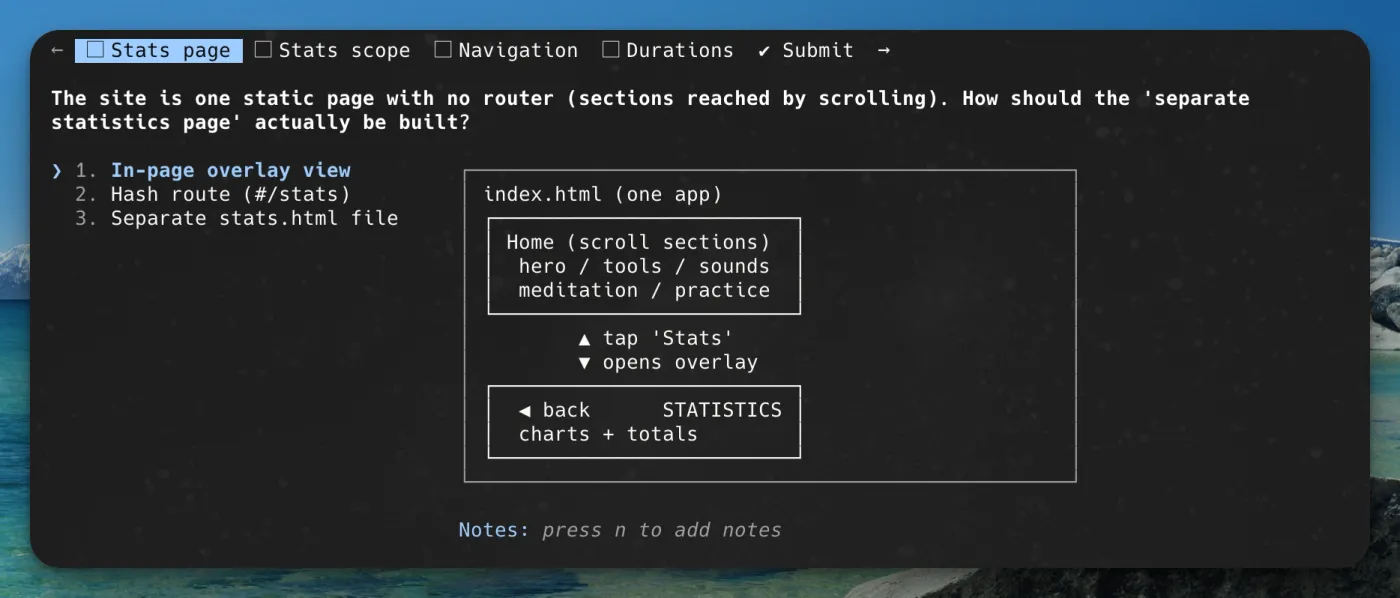
How do we deal with the fact that a separate page now has to be added to my project? How does the user reach the new statistics page?
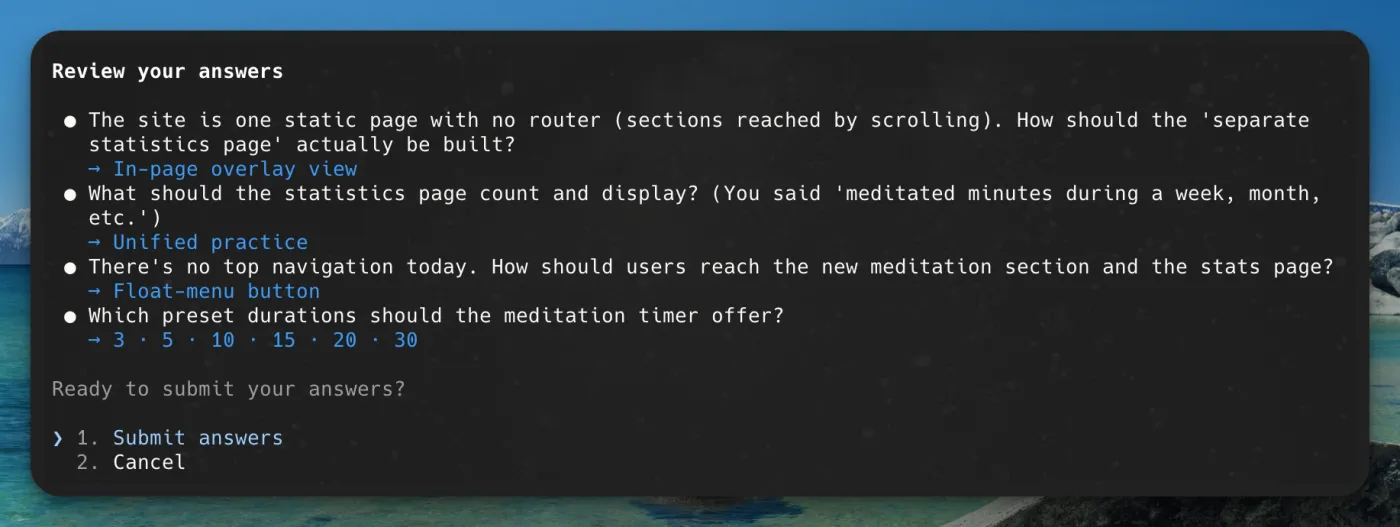
Once we have answered all the questions, the agent moves on with important context for implementing what we actually want, without us realising afterwards that we disagree with a decision that was already made, and losing valuable time and tokens (money!) reworking the whole thing.
Takeaway#
With the "Grill Me" skill, you write your base prompt, let the agent ask questions about every aspect of the architecture, and get back a complete implementation plan. Used well, it saves you a fair bit of time and follow-up prompts. So why not give it a try?